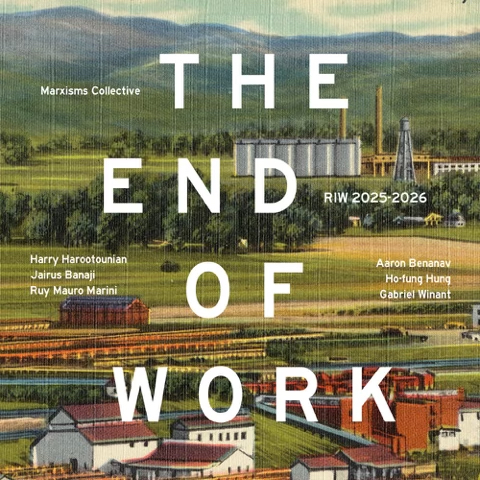
The End of Work

“AI isn’t coming for your job—it’s coming for your whole org chart” (Fast Company, 7/20/2025). “Behind the curtain: A white-collar bloodbath” (Axios). “How does it feel to be replaced by a bot?” (The Guardian). “Which workers will AI hurt the most: the young or the experienced?” (New York Times). The AI boom has sparked new and widespread fears of mass unemployment, deskilling, and the “end of work.” Yet the history of automation is as long as the history of capitalism itself. And here in the Rust Belt it is impossible to ignore that deindustrialization and the resulting transformation of work have been underway at least since the 1970s. So what is actually new about the present? What does work look like today, across the capitalist world system? Is the “end of work” really just around the corner—and what would that even mean? How has work changed over the last fifty years and what might these changes tell us about the future? More generally, how has the character of work changed over the long history of capitalism?

Building on our conversations during the 2024-2025 academic year under the theme of “crisis,” this year’s theme, The End of Work, aims to study the nature of work today. We will approach this question historically by reading the work of a series of thinkers and organizers representing a variety of disciplines and from both global North and South to better understand what work has looked like and how it has changed across the uneven structure of global capitalism over the last fifty years and beyond. Some of the theorists we intend to read include Ruy Mauro Marini (The Dialectic of Dependency), Jairus Banaji (Theory as History), Harry Harootunian (Marx after Marx), Aaron Benanav (Automation and the Future of Work), Gabriel Winant (The Next Shift), and Ho-fung Hung (TBD). We begin the year with Endnotes 4, “A History of Separation” which provides a historical perspective on the workers’ movement and considers the temporal and geographic contingencies of how we understand work. This sets us up to approach the question of labor through the lenses of subsumption, free labor, and super-exploitation as theorized by Harootounian, Banaji, and Marini, respectively. In the winter semester, we will turn to the work of Winant, Benanav, and Hung as we attend to some of the different contexts shaping the precarity of labor today. Throughout the course of the year, we engage with these historical perspectives in view of the need to rethink the concept of work.

If you would like to join the reading group please email sswartou at umich dot edu.

Shen Swartout, Felipe Moretti, Dan Nemser
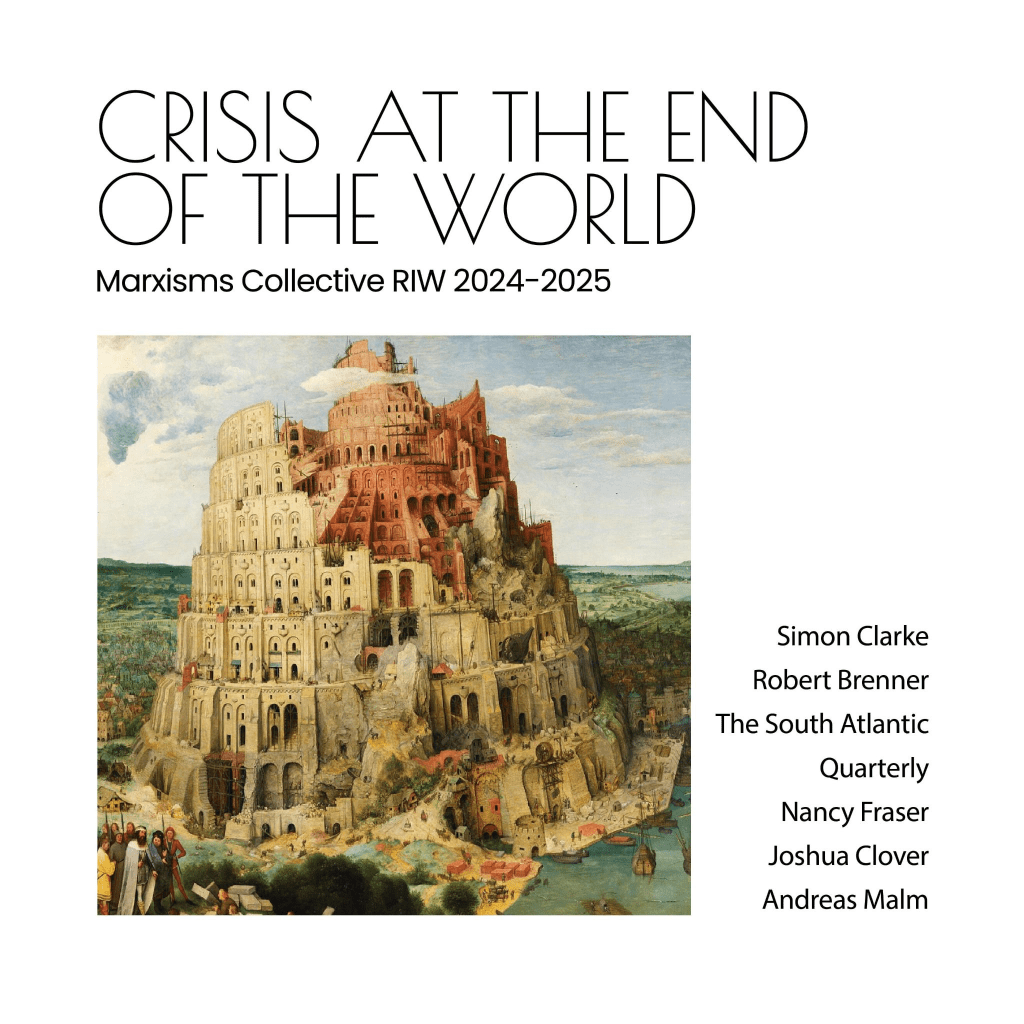
Crisis at the End of the World

Financial crisis. Ecological crisis. Migration and refugee crises. A crisis of mental health. An opioid crisis in the hollowed-out Rust Belt. The crisis of democracy. A global pandemic, a persistent recession, escalating war, an ever-heating planet: crisis. The word hangs in the air, like dust, and it seems to be on everyone’s lips these days. One doesn’t need to look at the news to feel it, and few alive today would wager that we live in a stable world. Surely, the American-led capitalist system that has spread across the world and into all facets of our daily lives is falling apart before our eyes. 

As much as people speak of “crisis,” the actual meaning of the word remains hazy. Is a crisis just when something goes wrong? Is it when the economy falters due to human error? Is a crisis an unpredictable deviation from the “normal”? Is it when things falter due to human error? Is a crisis an unpredictable deviation from the “normal”? Do all crises get resolved eventually? Are these accumulating emergencies, the so-called “polycrisis,” harbingers of the end of the world as we know it or just externalities of business as usual?

The Marxist tradition offers historical materialist frameworks for understanding why the dominant order appears to be so unstable in the present day. Despite their differences, Marxists generally agree that recurring crisis is internal to the workings of capitalism, which creates a potential opening for a radically alternative economic system to supersede it. As a result, crisis is fundamental to Marxism as a political project. Since the crisis of capitalism has permeated so many aspects of human existence, including the political, economic, ecological, and social, a comprehensive discussion of crisis is necessarily interdisciplinary and invites diverse academic perspectives. 

This year’s workshop, Crisis at the End of the World, will take stock of the conceptual tools provided by Marx and thinkers in the Marxist tradition to understand the nature of crisis and its import for those living through it. Our task this semester will be two-fold. In the fall semester, we will theorize crisis itself, covering the history of the concept in the 20th century and its use by Marxist thinkers today. We will read Simon Clarke’s study Marx’s Theory of Crisis (1994), which offers a foundational approach to theories of crisis in Marx and the Marxist tradition; Robert Brenner’s influential article on the 2008 financial crisis, “What is Good for Goldman Sachs is Good for America: The Origins of the Current Crisis” (2009); and a series of articles from a recent special issue of South Atlantic Quarterly (April 2024) which explore crisis as a method for understanding world developments such as the rise of fascism. 

In the winter semester, we will turn our attention to the various forms in which the present crisis expresses itself. We will read Nancy Fraser’s Cannibal Capitalism (2022), which discusses how capitalism sustains itself on unstable social reproductive contradictions, including racialization and the gendered labor of care; Joshua Clover’s Riot. Strike. Riot. (2016), which draws on Brenner’s concept of the long downturn to make sense of the upsurge in mass street protests that have erupted worldwide in recent years; and Andreas Malm’s White Skin, Black Fuel (2021), which explores the interconnected rise of far-right nationalist ideologies and climate change, rooted in capitalism’s dependence on fossil fuels. We will conclude our workshop with a screening and discussion of the recent film How to Blow Up a Pipeline (2022), an action thriller based on another book by Malm and grounded in the urgency of climate catastrophe and the fatal inaction of elite institutions to avert it.

If you would like to join the reading group please email fmoretti at umich dot edu and pchatha at umich dot edu.

Prayag Chatha, Felipe Moretti, Dan Nemser

promotional flyer for Marxisms Collective

Capitalism and the “free gift of Nature”

The 2023 boreal summer broke heat records across the globe. Wildfires, droughts, and floods are increasingly frequent. But these symptoms of broader global climate changes also entail a broader transition in the history of our ecological system. We are entering a new geological age that Earth system scientists have called the “Anthropocene.” But is this planetary crisis caused by an abstract “Human” (or “Anthro”)? Or by a specific historical set of relations of production called capitalism? Perhaps, as Andreas Malm has posited, it is more adequate to state that we live in the Capitalocene. 

While the appropriation of nature takes place across all human communities and all social relations of production, the planetary crisis we are now facing is an effect of the ongoing process of destructive appropriation that puts all human and extra-human life at risk. An unprecedented and irrational squandering of nature in the past half century has produced what John Bellamy Foster has called, following Marx, a “metabolic rift.” This is not the result of human modes of appropriation of nature in general but of a specific mode of appropriation – the appropriation of what Marx called the “free gift of Nature” (human and extra-human alike) by capital. 

In the Fall semester, we will take stock of the conceptual tools produced by Marx, Engels, and other thinkers who have taken the critique of capitalism as a central focus point in their accounts of the current ecological planetary crisis. We will read from Kohei Saito’s Marx in the Anthropocene: Towards the Idea of Degrowth Communism (2022) and Jason W Moore’s Anthropocene or Capitalocene? Nature, History and the Crisis of Capitalism (2016), Paul Burkett’s Marx and Nature. A Red and Green Perspective (1999) and John Bellamy Foster’s seminalMarx’s Ecology: Materialism and Nature(2000). What conceptual tools have Marxists produced to describe and understand the planetary crisis? How should these conceptual tools be sharpened today? How do they differ from other dominant ecological approaches?

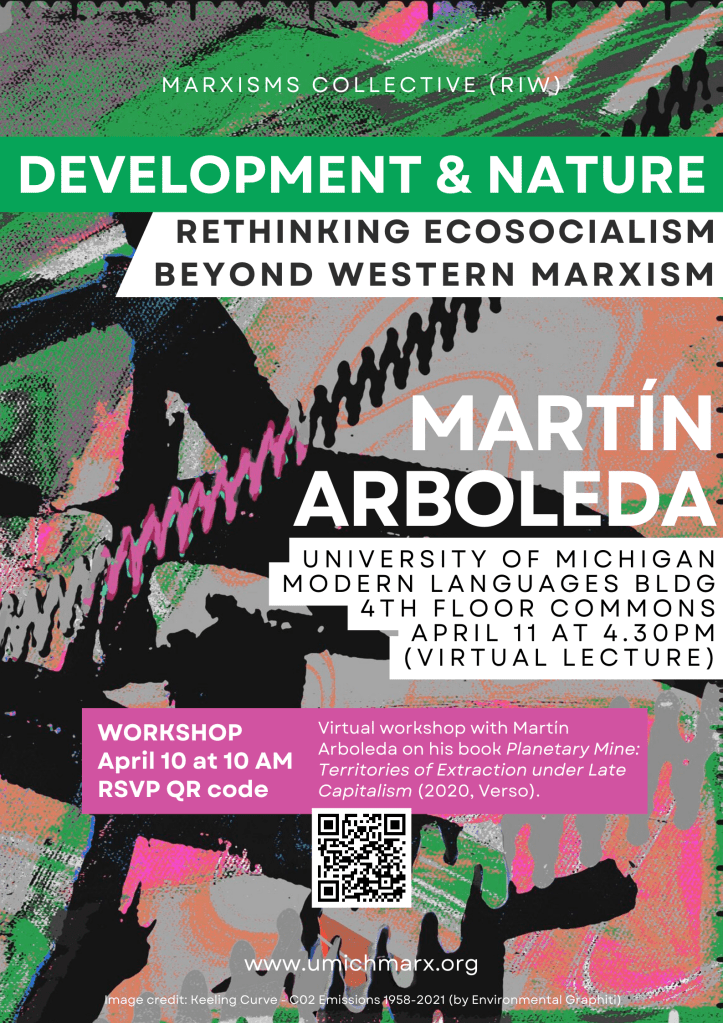
During the Winter semester, we will engage the history of capitalism alongside the history of the extraction of fossil fuels through Andreas Malm’s Fossil Capital (2016). Then we will turn to contemporary struggles on resource extraction and the political challenges it poses in Latin America by engaging with Thea Riofrancos’ Resource Radicals: From Petro-Nationalism to Post-Extractivism in Ecuador (2020) and Martin Arboleda’s Planetary Mine: Territories of Extraction under Late Capitalism (2020). 

If you would like to join the reading group please email alejo AT umich DOT edu and mlauram AT umich DOT edu.

Maria Laura, Alejo and Dan Nemser

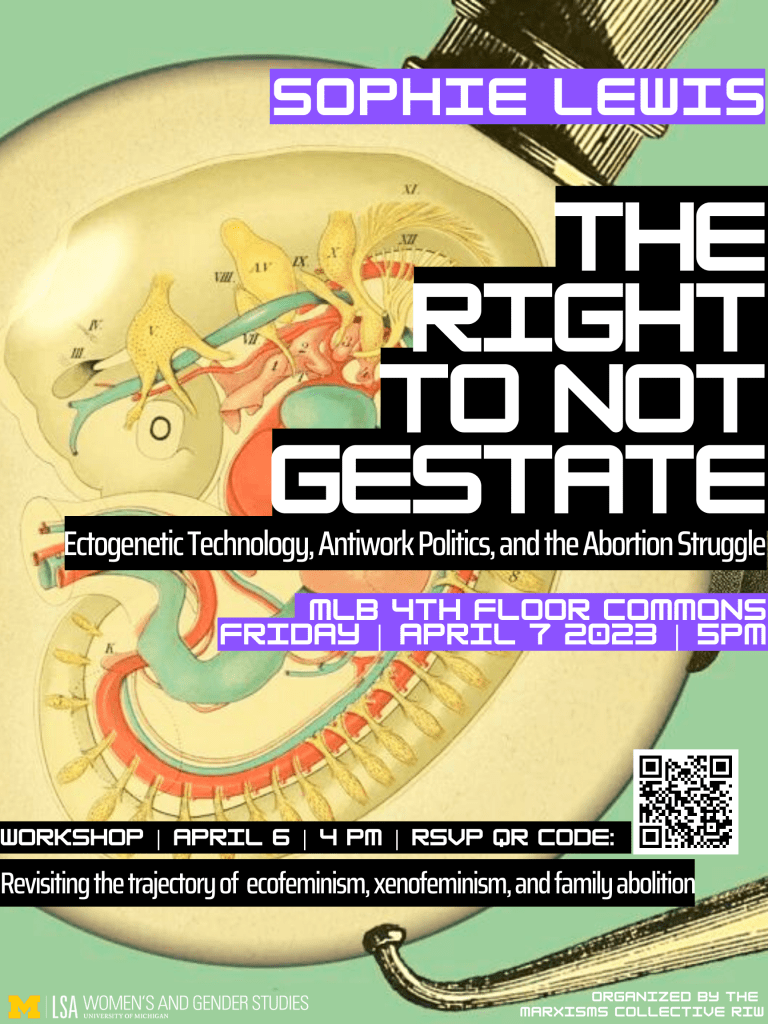
Sophie Lewis at UMich (April 6-8)*

Talk: “The right to not gestate: Ectogenetic technology, antiwork politics, and the abortion struggle”
April 7 at 5 pm (MLB 4th floor commons)

Workshop: “Revisiting the trajectory of ecofeminism, xenofeminism, and family abolition.” 
April 6 at 4 pm (RSVP to QR code below). 

In preparation for the workshop, the Marxisms collective will be reading part of Lewis’ work (alongside Haraway, Firestone, and Hester) in the coming weeks. If you’d like to join our reading group (which starts next week), please email me directly at alejo AT umich DOT edu.


*Event co-sponsored with Women’s and Gender Studies at the University of Michigan.

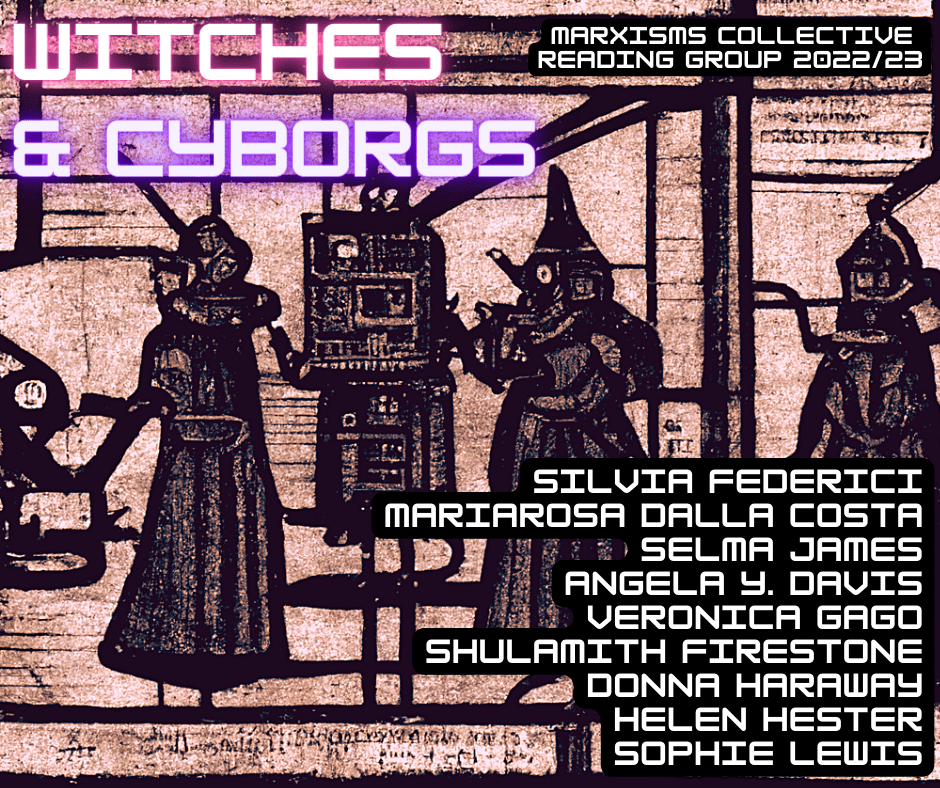
Witches and cyborgs: Materialist feminist debates on extractivism, technoscience, and reproduction


This year the marxisms collective RIW will focus on coordinating a series of reading and discussion groups on a theme tentatively titled “Witches and cyborgs: Materialist feminist debates on extractivism, technoscience, and reproduction.” Throughout the year we will be engaging with the writings of Silvia Federici, Mariarosa Dalla Costa, Selma James, Angela Y. Davis, Veronica Gago, Shulamith Firestone, Donna Haraway, Helen Hester and Sophie Lewis.

In the wake of the pandemic and the proliferation of class struggles for social reproduction and against racialized and gendered forms of premature death a crisis that looms over all struggles is that of ecological disaster. How have materialist feminists theorized the interlocking aspects of this multifaceted crisis? 

On the one hand, in feminist struggles throughout the world the archaic figure of “the witch” emerges as a disruptive naturalist force against the contemporary forms of extraction (of bodies, territories and in digital worlds). This is perhaps most clearly theorized by Silvia Federici’s seminal book Caliban and the Witch: Women, the Body and Primitive Accumulation and also been taken up by feminist thinker Veronica Gago in the wake of the Latin American feminist “green tide” (see Feminist International: How to change everything). 

On the other hand, in contemporary struggles it is also possible to trace the distinct futurist figure of “the cyborg” which turns towards the repurposing of capitalist technoscience for emancipatory goals. This tendency can be read in the works of Donna Haraway’s “A cyborg manifesto” and, more recently, in the anti-naturalist, technomaterialist and gender abolitionist variants of “xenofeminism.” The vital relevance of these debates on reproduction, extractivism and technoscience can also be read in the recent (and to some quite polemical) call by Sophie Lewis – following the “cyborg” and xenofeminist line– to abolish the family. 

A group of us have selected a series of writings that will frame some of the relevant debates that span the spectrum delimited by these two apparent polarities.

Our first meeting will be on Friday, September 23, at 4pm via Zoom. We will begin by reading and discussing a chapter of Silvia Federici’s Caliban and the Witch: Women, the Body and Primitive Accumulation titled “The great-witch hunt in Europe” and a more recent essay titled “Re-enchanting the World: Technology, the Body, and the Construction of the Commons.”

If you are interested in a PDF of the readings and in joining us in the reading group this year please email alejo AT umich DOT edu

Image credit: Midjourney

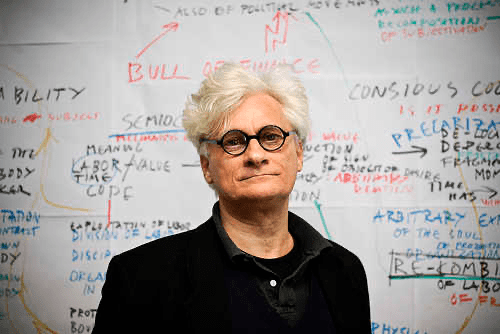
Bifo @ UMich

Friday, December 10 via Zoom

Lecture
“Resignation: A Strategy”
3:00-4:30 PM EST

Workshop
“On Marx and Marxism”
 10:00-11:30 AM EST

Franco “Bifo” Berardi is a writer, media theorist, and media activist. He founded the magazine A/traverso (1975-1981) and was part of the staff of Radio Alice, the first free pirate radio station in Italy (1976-1978). Like other intellectuals involved in the political movement of Autonomia in Italy during the 1970’s, he fled to Paris, where he worked with Félix Guattari in the field of schizoanalysis. Contributor to journals such as Semiotext(e) (New York), Chimères (Paris), and Archipiélago (Barcelona), he is the author of many books, including The Soul at Work (MIT, 2009), Futurability: The Age of Impotence and the Horizon of Possibility (Verso, 2017), Breathing: Chaos and Poetry (MIT, 2018), and The Third Unconscious (Verso, 2021).


This event is hosted by the Department of Romance Languages and Literatures and the Marxisms Collective.


Questions? Contact Vincenzo Binetti (vbinetti AT umich DOT edu) and Gavin Arnall (garnall AT umich DOT edu).